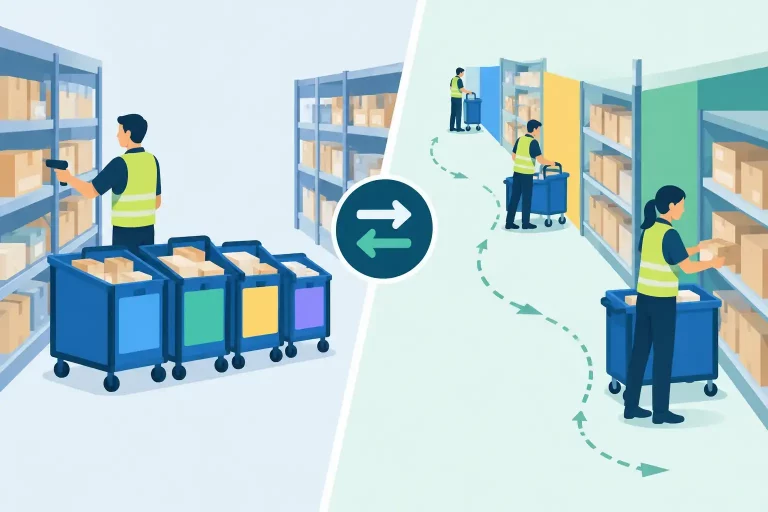
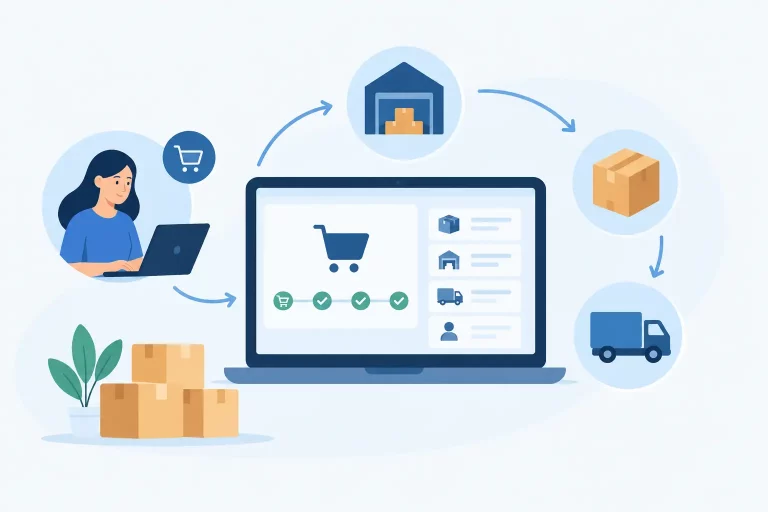
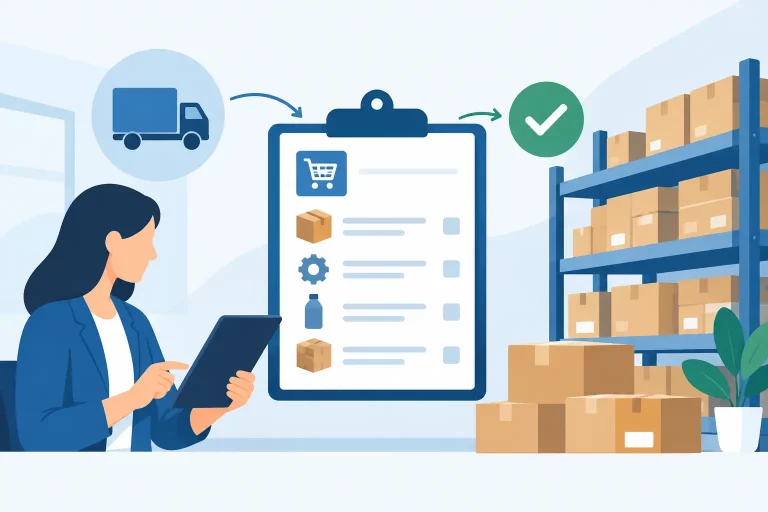
A warehouse can lose hours each day when pickers walk the same aisles repeatedly for separate orders. The right picking method reduces that wasted movement, keeps orders moving to packing on time, and gives operations teams more control when demand spikes. In the choice between batch picking versus wave picking, the better fit depends on order volume, product mix, labor availability, carrier cutoffs, and how much coordination your fulfillment floor can support.
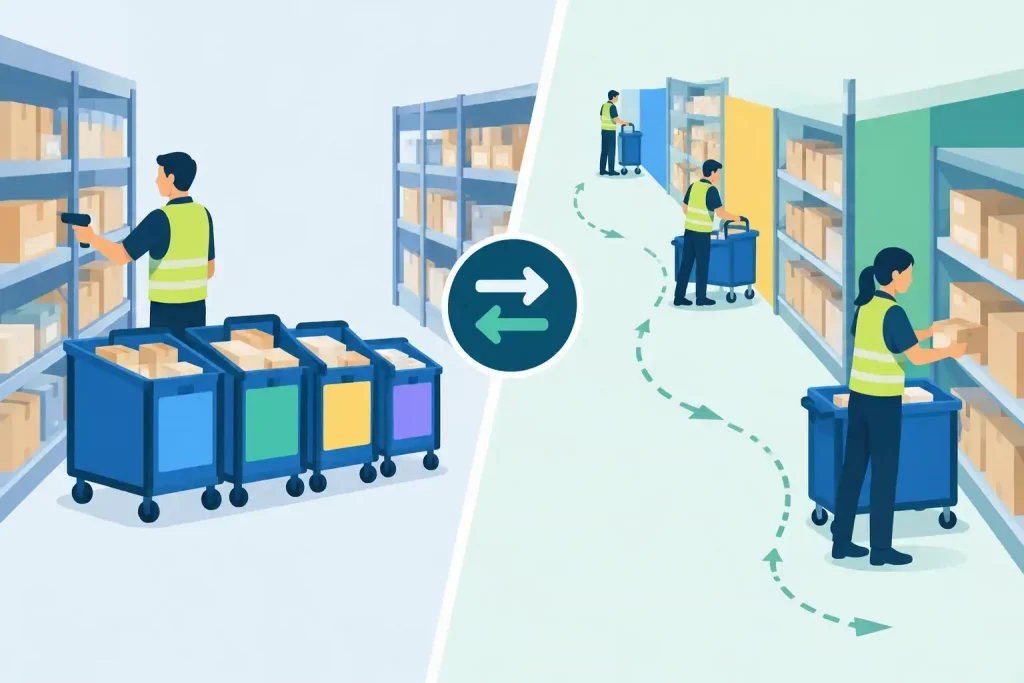
Both methods consolidate work more effectively than picking one order at a time. They solve different problems, though. Batch picking is built for efficient collection of similar items across multiple orders. Wave picking is built for scheduling and controlling how work moves through the warehouse. Understanding that distinction helps merchants avoid adopting a process that looks efficient on paper but creates congestion, packing delays, or inventory mistakes in practice.
What Is Batch Picking?
Batch picking groups multiple orders into a single picking trip. Instead of walking to a bin for Order 1001, returning to start, and then walking back to the same bin for Order 1002, a picker collects the combined quantity needed for both orders during one route.
For example, if 20 orders each include the same best-selling water bottle, the picker can retrieve 20 units in one visit to that location. Those items are then sorted into individual orders at the cart, a sorting station, or the packing area. The process is especially effective when many orders share SKUs and the warehouse carries a manageable number of items per order.
The primary benefit is less travel time. In many fulfillment environments, walking is the largest component of pick labor. A well-designed batch can reduce aisle travel significantly without requiring major changes to inventory layout.
Where batch picking performs best
Batch picking typically works well for high-volume direct-to-consumer orders with small baskets, repeat products, and predictable demand. It is a practical choice for merchants shipping dozens or hundreds of similar orders each day, particularly when fast-moving inventory is stored in accessible pick locations.
It is also useful during a promotion or marketplace event that drives demand toward a narrow group of products. Rather than assigning pickers to individual orders, operations managers can create batches around the highest-volume SKUs and clear the work quickly.
The trade-off is sorting complexity. Once items are collected, the team must reliably separate them into the right orders. If a picker handles too many orders in one batch, or if carts and totes are not clearly organized, accuracy can decline. Batch picking saves time only when the downstream sorting process is controlled.
What Is Wave Picking?
Wave picking releases orders to the warehouse in planned groups, or waves, based on operational priorities. A wave may be organized by shipping deadline, carrier, order type, warehouse zone, customer service level, or a specific time window. The warehouse team picks, packs, and ships that group before moving to the next wave.
A common example is a morning wave for orders that must meet an early carrier pickup, followed by an afternoon wave for standard shipments. Another operation may release separate waves for wholesale orders, expedited DTC orders, and marketplace orders with strict service-level requirements.
Wave picking is not only about how a picker travels through the warehouse. It is a method for managing the entire fulfillment schedule. It gives managers a way to align picking labor, packing capacity, replenishment activity, and carrier deadlines.
Where wave picking performs best
Wave picking is often the stronger option for larger or more complex operations. It suits warehouses that process multiple sales channels, use several carriers, handle a mix of parcel and pallet orders, or need to prioritize certain orders throughout the day.
It can also help teams prevent packing stations from becoming overwhelmed. By releasing work in controlled intervals, managers can avoid sending more completed picks to packing than the team can process. That pacing matters when labels, inserts, carrier services, or order exceptions require attention.
The risk is that rigid wave schedules can slow responsive fulfillment. If an urgent order arrives just after a wave is released, it may wait until the next cycle unless the warehouse has an exception process. Poor wave planning can also leave pickers idle between releases or create a rush near a carrier cutoff.
Batch Picking Versus Wave Picking: The Core Difference
The central difference is simple: batch picking determines how orders are collected, while wave picking determines when and why work is released.

Batch picking focuses on route efficiency. It combines demand for the same inventory locations to reduce repetitive movement. Wave picking focuses on operational timing. It organizes order release around deadlines, capacity, and fulfillment priorities.
That means these methods are not always mutually exclusive. A warehouse can release a wave of priority orders at 10:00 a.m., then batch-pick the shared SKUs within that wave. This combination is common in operations that need both speed on the floor and control over the shipping schedule.
For multichannel merchants, that layered approach can be particularly valuable. Marketplace orders may have different handling rules than Shopify orders, wholesale accounts may require different pack configurations, and expedited shipments cannot wait behind low-priority work. Wave logic can set the priorities, while batch logic reduces the labor required to fulfill them.
How to Choose the Right Picking Method
Start with your order profile rather than the method that appears most advanced. A warehouse with 300 daily orders containing one or two repeat items has different needs from a warehouse with 300 daily orders made up of varied, multi-line baskets.
Batch picking is usually the better first move when travel time is high, orders share common SKUs, and individual orders contain few lines. It is easier to introduce when the team has carts, totes, barcode scanning, and a clear process for separating orders after collection.
Wave picking becomes more valuable when fulfillment needs to follow a deliberate schedule. If your team regularly misses carrier cutoffs, struggles to prioritize expedited orders, or experiences bottlenecks between picking and packing, waves can create the discipline missing from the workflow.
Consider inventory layout as well. Batch picking produces the strongest gains when fast-moving products are easy to reach and pick paths are organized. If top sellers are scattered across distant zones, a batch may still involve unnecessary travel. Slotting high-volume items closer to packing and replenishing those locations consistently can improve results before you change picking rules.
Order accuracy should remain a deciding factor. A faster workflow that increases mispicks, short shipments, or customer complaints is not an efficiency gain. Barcode-based verification, clearly labeled totes, and real-time inventory updates are especially important when multiple orders are being handled together.
Build a Controlled Fulfillment Workflow
The most effective picking process starts with accurate order and inventory data. If stock counts are unreliable, pickers can waste time searching for items that are unavailable, while customer service teams deal with avoidable substitutions and cancellations. If orders from marketplaces, online stores, and B2B channels are not centralized, prioritizing work becomes harder than it needs to be.
A connected commerce operations platform gives warehouse teams a single view of incoming orders, inventory by location, shipping requirements, and fulfillment status. With eSwap, merchants can centralize multichannel order flow and inventory visibility, making it easier to release the right work to the warehouse and keep stock synchronized as orders move through fulfillment.
Process design matters just as much as software. Set practical rules for batch size, wave timing, exception handling, and replenishment. Test them against real order patterns for at least several shipping cycles. Watch for signs of trouble: carts waiting too long at packing, repeated stockouts in pick locations, late label creation, or a rise in order corrections.
Do not assume one method must run the whole warehouse. A small team may batch pick standard DTC orders while handling wholesale orders separately. A growing operation may wave-pick by carrier cutoff in the morning and use flexible batches later in the day. The right process is the one that protects accuracy while keeping labor and shipping capacity in balance.
As order volume grows, picking should become more intentional, not more complicated. Use batch picking to eliminate wasted travel. Use wave picking to protect deadlines and control workload. Then keep measuring the points where orders slow down, because that is where the next operational improvement will pay off.