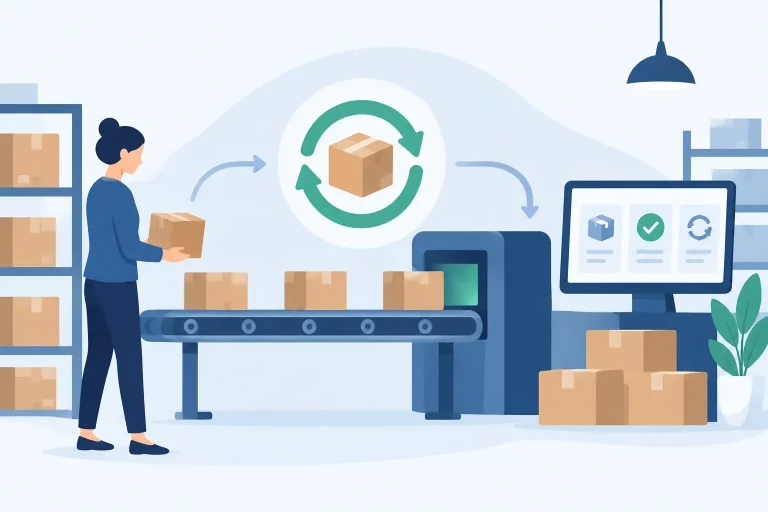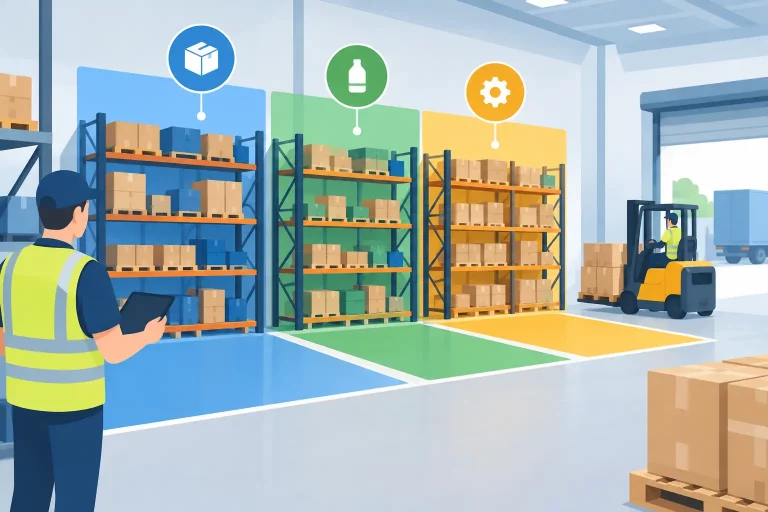
A wrong item, missing accessory, duplicate shipment, or late carrier handoff can turn a profitable order into a costly service issue. Learning how to reduce fulfillment errors is not just a warehouse exercise. For multichannel sellers, it requires control over the data and workflows that shape an order from checkout through delivery.
Fulfillment mistakes usually appear at the packing station, but their cause often starts earlier: inventory is out of sync, product data is unclear, orders are routed manually, or warehouse teams are working from incomplete information. The most reliable fix is to build one connected operating process rather than asking people to be more careful inside disconnected systems.
Why fulfillment errors rise as order volume grows
At low volume, teams can compensate for weak processes with memory, manual checks, and informal communication. That approach breaks down when orders arrive from multiple storefronts, marketplaces, wholesale accounts, and warehouses. A team may be handling similar SKUs with different packaging requirements, split shipments, channel-specific service levels, and changing stock availability all at once.
The common error types are familiar: shipping the wrong SKU, sending the wrong quantity, using an incorrect address or shipping method, failing to include required inserts, and overselling inventory that was already committed elsewhere. Each one creates direct costs through reshipments, returns, labor, carrier charges, and customer support. On marketplaces, fulfillment defects can also affect seller performance and account health.
The operational goal is not to add a review step to every order. Too many manual checks slow the warehouse without eliminating the underlying source of bad data. The goal is to make the correct action the easiest action at every stage.
How to reduce fulfillment errors with a controlled workflow
Start with one accurate source of inventory truth
Inventory accuracy is the foundation of fulfillment accuracy. If available stock differs across your online store, marketplaces, wholesale orders, and warehouse records, staff may pick items that are not actually available or promise delivery dates they cannot meet.
Centralize inventory updates so a sale, return, transfer, purchase receipt, or adjustment changes stock visibility everywhere it needs to. Reserve inventory as orders are created, not after someone begins picking. This matters especially when the same SKU is sold across fast-moving channels such as Amazon, eBay, Shopify, Walmart, and B2B order portals.
Inventory controls should also account for stock that is physically present but not sellable. Damaged units, quality-control holds, customer returns awaiting inspection, and inventory assigned to a specific wholesale customer should not appear as free-to-sell stock. Accurate statuses prevent teams from making decisions based on an inflated available quantity.
Cycle counting is still necessary, even with strong software. High-velocity products, products with frequent returns, and small or easy-to-misplace items deserve more frequent counts. Use count variances as a signal to investigate receiving, putaway, picking, or product setup rather than treating adjustments as routine cleanup.
Clean up SKUs, barcodes, and product attributes
A picker cannot reliably identify the right item when the catalog is confusing. Similar items need distinct SKUs, scannable barcodes, accurate product names, and clear variant attributes. A black medium shirt and a navy medium shirt may look nearly identical in a rushed pick environment, so the system must give the team a dependable way to distinguish them.
Standardize SKU logic before adding more channels or warehouse locations. Avoid supplier codes that change without warning, duplicate SKUs across brands, and product titles that omit size, color, pack count, or compatibility details. If an item is sold individually and in a bundle, both records should clearly define what is picked and how inventory is consumed.
Product data should also include operational instructions. Record whether an item requires special packaging, a serial-number scan, a hazardous-material label, an insert, or a signature service. Keeping those details inside the fulfillment workflow reduces dependence on handwritten notes and tribal knowledge.
Use barcode verification at pick and pack
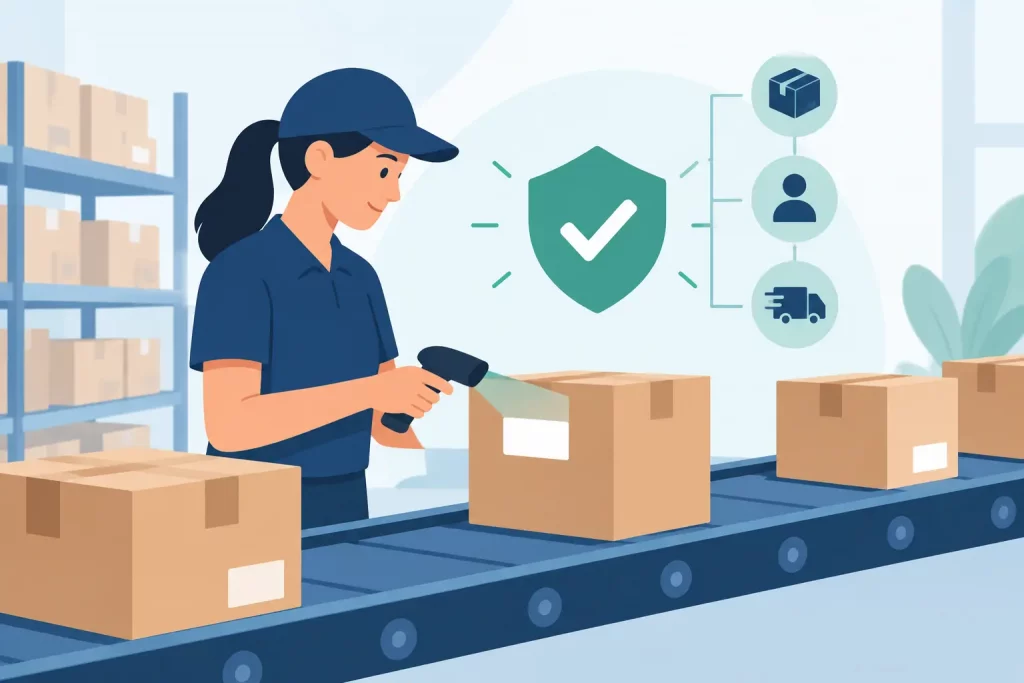
Barcode scanning is one of the most direct ways to prevent wrong-item and wrong-quantity errors. At the pick stage, a scan confirms that the worker is taking the SKU assigned to the order. At packing, a second scan verifies that each required item is in the shipment before the label is produced.
The appropriate level of scanning depends on order complexity. A small operation with simple, single-SKU orders may start with pack verification. A warehouse managing hundreds of SKUs, multiple bins, and frequent multi-line orders should scan locations, items, and shipments. The extra seconds per order are usually less costly than rework, refunds, and lost customer confidence.
Scanning only works when barcodes and bin locations are maintained. Establish a process for relabeling damaged barcodes, correcting misplaced products, and quarantining unknown inventory. Do not allow workers to bypass scan exceptions casually. Exceptions should have a reason code so operations leaders can identify recurring catalog or warehouse issues.
Design picking routes for the warehouse you actually run
Poor warehouse layout creates errors because it forces people to rush, backtrack, and make choices among similar products. Place high-volume SKUs in accessible locations, separate lookalike items, and label every pick face clearly. If a product is regularly confused with another item, physical separation may be more effective than another training reminder.
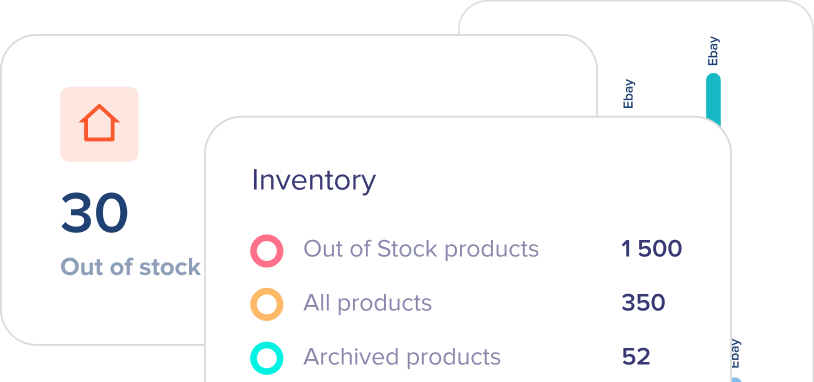
Batch picking can improve speed for many small orders, while zone picking works well in larger facilities where different teams handle defined sections. Wave picking may be useful when carrier cutoffs and service levels drive priorities. There is no single best method. The right model depends on order profiles, SKU count, warehouse size, and the number of workers on each shift.
What matters is that the warehouse management process directs work in a predictable order. Pickers should know which orders are urgent, where to go next, and what exception path to follow when an item cannot be found. Manual searching and verbal reassignment introduce avoidable variation.
Automate order routing and shipping decisions
Manual order decisions multiply quickly across channels. If staff must choose a warehouse, carrier service, package type, or shipping method for every order, errors become likely during busy periods. Rules-based automation can route orders based on inventory availability, customer location, promised service level, product restrictions, and warehouse capacity.
Shipping automation should validate the address, apply the correct service, and produce labels from the same order record used by the warehouse. That prevents a common failure: a team picks against one version of an order and ships against another. It also reduces the risk of selecting an expensive service when a lower-cost option meets the delivery commitment.
For businesses with multiple fulfillment locations, define clear logic for split shipments. Shipping from two locations may protect delivery speed, but it also increases packing, carrier, and customer communication complexity. Use splits when they improve the customer outcome or protect a critical service level, not simply because inventory happens to be fragmented.
Make receiving and returns part of fulfillment quality
Many fulfillment errors are created before an order arrives. Receiving mistakes put incorrect counts or products into available inventory, while weak returns processes can return unsellable or incorrect items to stock. Both problems eventually reach the customer as a picking error or stockout.
Require receiving teams to verify purchase order quantities, SKUs, and condition before inventory becomes available. For returns, inspect items and assign a defined disposition: restock, refurbish, quarantine, or dispose. A return should not reenter active inventory until the item and its status are confirmed.
This closed-loop discipline is particularly valuable for sellers with frequent exchanges, bundled products, or serialized merchandise. It preserves the integrity of inventory data across the full product lifecycle.
Measure the errors that reveal process failures
Track more than overall order accuracy. A single percentage can hide recurring problems in a specific channel, shift, warehouse zone, SKU family, or carrier service. Review wrong-item rate, short-shipment rate, late-shipment rate, address correction rate, inventory adjustment frequency, and reshipment cost.
When an error occurs, capture the reason at the point of discovery. Was the product mislabeled, the bin incorrect, the order edited after picking, the barcode missing, or the inventory record wrong? A useful error log identifies process patterns without turning every mistake into a personnel issue.
A centralized commerce operations platform such as eSwap can help teams connect inventory, orders, warehouse activity, and shipping in one operating view. That visibility makes it easier to enforce consistent workflows across channels and identify where exceptions are being created.
Train for exceptions, not just standard orders
Standard orders are usually straightforward. The real test is what happens when stock is missing, an address fails validation, a bundle component is unavailable, or a customer changes an order after release. Teams need documented rules for these situations, including who can approve substitutions, edits, inventory adjustments, and shipping upgrades.
Keep instructions close to the workflow and review them when processes change. Training should include hands-on scans, packing checks, and exception scenarios, not only a written procedure. A team that understands why each control exists is more likely to follow it under pressure.
The strongest fulfillment operation is not one that never encounters exceptions. It is one that catches them early, resolves them consistently, and uses every pattern to improve the next order.