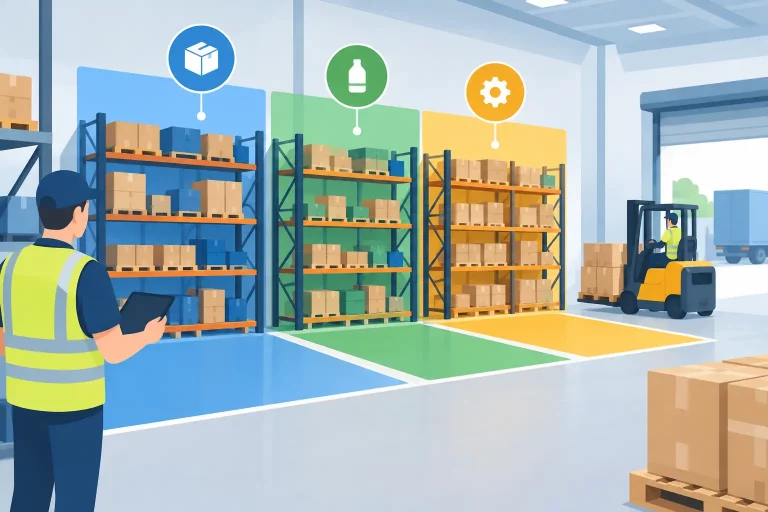
A customer orders the last available unit on Amazon, but the item was already allocated to a wholesale order in another facility. The sale looks successful until the fulfillment team cannot find the stock. Inventory visibility across warehouses prevents this type of avoidable failure by showing what is physically available, reserved, in transit, damaged, or committed to an order before another channel can sell it.

For multichannel merchants, warehouse growth often creates a new layer of operational risk. A second location can shorten delivery times and increase capacity, but only when every team and sales channel works from the same inventory truth. Without that control, more warehouses can mean more spreadsheet updates, more stock discrepancies, and more expensive customer service work.
Why Warehouse-Level Inventory Visibility Matters
A total stock count is not enough. Knowing that you have 500 units of a SKU across three locations does not tell an operations manager whether 450 units sit in a warehouse that cannot meet a two-day delivery promise, whether 30 units are quarantined for quality checks, or whether 20 units have already been assigned to open orders.
Warehouse-level visibility separates inventory by location and status. It gives teams a usable answer to the questions that determine whether an order can be fulfilled: What can be sold now? Where is it? Which orders already claim it? What stock is arriving, and when?
That distinction protects margin as well as customer experience. When available stock is accurate by warehouse, businesses can route orders to the most appropriate fulfillment location, reduce split shipments, and avoid paying for unnecessary expedited shipping. Inventory planners can also identify slow-moving stock in one region before placing another purchase order for the same item.
The value grows when a merchant sells through multiple channels. Shopify, Amazon, eBay, Walmart, B2B orders, and sales representatives can all create demand against the same pool of inventory. If each channel receives inventory updates on a delay, overselling becomes a timing problem. If they receive updates from a centralized system, stock availability becomes a controlled business rule.
What Good Inventory Visibility Across Warehouses Looks Like
Effective visibility is not simply a dashboard with location names. It is a connected operational process that updates stock when real work happens: receiving a purchase order, moving inventory between bins, picking an order, creating a shipment, canceling a sale, or completing a return.
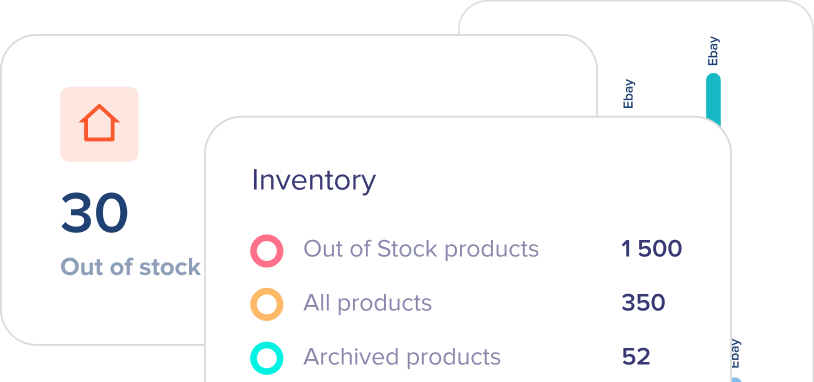
At minimum, an operations team should be able to see on-hand, available, allocated, and incoming quantities for every SKU at every warehouse. On-hand stock is the physical count. Available stock is what remains sellable after allocations, holds, safety stock rules, and other commitments. Treating these numbers as interchangeable is a common source of overselling.
Location detail matters inside each warehouse as well. A warehouse may have inventory in receiving, bulk storage, pick faces, returns, and damaged-goods areas. A unit in receiving may be physically present but not yet ready to sell. A unit in a returns area may need inspection before it can go back into available inventory. Clear statuses keep teams from promising stock that cannot actually ship.
The system also needs to show movement, not just balances. When a SKU is transferred from a West Coast facility to a Midwest warehouse, the transfer should reduce availability at the origin, record inventory in transit, and increase the destination count only when the receiving team confirms it. Otherwise, teams can accidentally sell the same units from both locations during the transfer window.
The Operational Problems Visibility Solves
Poor visibility usually shows up first as overselling, but the damage extends across the operation. A customer may receive a cancellation notice, a warehouse team may pick the wrong location, and a buyer may reorder inventory that already exists elsewhere in the network.
Accurate warehouse data helps reduce several costly problems:
- Overselling across marketplaces and storefronts when channel stock updates lag behind order activity.
- Split shipments caused by routing orders without considering available inventory at the best location.
- Excess purchasing because planners cannot see stock sitting in another warehouse or sales channel.
- Slow order processing when employees must call, message, or search spreadsheets to confirm where an item is stored.
- Stockout surprises created by inventory that is allocated, damaged, in transit, or otherwise unavailable despite appearing in the total count.
There is a trade-off to consider. Some businesses choose to dedicate specific inventory quantities to specific channels or regions. This can protect a strategic marketplace or guarantee stock for wholesale customers, but it can also leave sellable inventory stranded. Shared inventory pools generally improve utilization, while channel buffers can improve predictability. The right approach depends on fulfillment capacity, marketplace commitments, lead times, and the cost of a stockout for each customer segment.
Build a Reliable Warehouse Inventory Process
Technology cannot correct inventory data if warehouse transactions happen outside the system. The goal is to make the correct process faster than the workaround.
Start With One Product and Location Record
Every sellable item needs a consistent SKU, product description, unit of measure, and warehouse assignment. Duplicate SKUs, informal product names, and inconsistent pack sizes make centralized visibility unreliable from the start. A case of 12 and a single unit should be clearly defined, particularly when purchasing, wholesale sales, and fulfillment teams use different quantities.
Each physical location should also have a standard naming structure. This applies to separate warehouses, but it also applies to zones, aisles, shelves, bins, and virtual locations such as quarantine or inventory in transit. Operators should not have to guess whether “WH2,” “East Facility,” and “New Jersey” describe the same site.
Record Inventory Events as They Occur
Receiving, transfers, adjustments, picks, shipments, returns, and write-offs should update inventory immediately. Delayed batch entries create a false view of availability precisely when order volume is highest.
Barcode scanning can reduce manual errors, especially for businesses with high SKU counts or frequent warehouse transfers. For lower-volume operations, disciplined receiving and picking workflows may be sufficient at first. The standard should be the same in either case: every physical movement must have a matching system transaction.
Set Clear Allocation and Safety Stock Rules
An order should reserve inventory when the business has committed to fulfill it, not only when a label is printed. This is particularly important when wholesale orders, marketplace orders, and direct-to-consumer orders compete for the same SKU.
Safety stock rules add another layer of control. A merchant may keep a fixed buffer at each warehouse, or calculate buffers based on demand velocity and supplier lead time. Fixed buffers are easier to manage, while demand-based rules can improve capital efficiency. Neither works if the underlying available quantity is inaccurate.
Automate Channel Updates and Order Routing
A centralized commerce operations platform should push inventory changes to connected sales channels as orders and stock movements occur. It should also bring orders back into the same system before warehouse teams begin fulfillment. Running inventory in one tool and orders in another creates the delay that visibility is meant to eliminate.
Routing rules should reflect operational priorities. A business may choose the nearest warehouse, the location with complete inventory for the order, the facility with the fastest cutoff time, or the warehouse with lower shipping costs. There is no universal rule. For example, shipping from the closest location can be inefficient if it forces a second package from another warehouse. Good routing considers the whole order, not just the customer ZIP code.
Turn Visibility Into Better Inventory Decisions
Once warehouse inventory is trustworthy, teams can move beyond firefighting. Operations managers can compare inventory position against open orders and incoming purchase orders. Buyers can spot regional imbalances before they become stockouts. Fulfillment leaders can see whether one location is carrying too much of the picking workload.
Useful reviews should focus on exceptions rather than forcing teams to inspect every SKU. Look for inventory below reorder points, high-demand items concentrated in the wrong region, aging stock with little movement, open transfers that have not been received, and repeated adjustment activity for the same products or locations. These are signals that point to a process issue, a demand change, or a catalog problem.
For growing merchants, a platform such as eSwap can centralize inventory, orders, purchasing, warehouse activity, shipping, and multichannel listings in one operational dashboard. That creates a shared record for sales, warehouse, and purchasing teams, reducing the handoffs that cause stock data to drift.
Make Accuracy a Daily Operating Standard
Inventory visibility is sustained through routine controls, not a one-time implementation. Cycle counts should target high-value, high-volume, and frequently adjusted SKUs more often than stable long-tail products. Investigate meaningful variances quickly, while the receiving, picking, or transfer activity is still easy to trace.
It also helps to assign ownership. Warehouse teams own physical transaction discipline. Operations leaders own workflow design and exception review. Inventory planners own replenishment decisions. When every discrepancy belongs to everyone, it often belongs to no one.
The practical goal is simple: when a team member sees an available quantity, they should be able to trust that it can be sold and shipped from the stated location. Build your processes around that standard, and each additional warehouse becomes a source of speed and capacity rather than another blind spot.