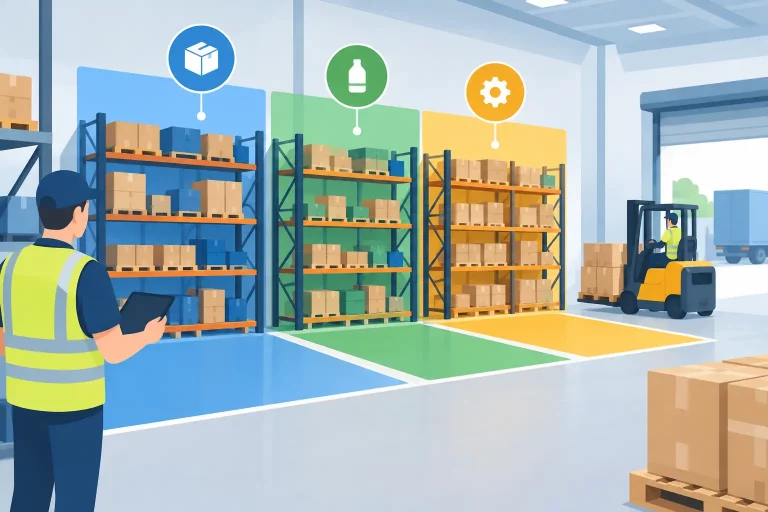
A warehouse can process hundreds of orders in a day and still lose money on preventable mistakes. A picker walks to the wrong bin, a received item is not posted to available stock, or two sales channels sell the last unit at once. Warehouse management is the operating discipline that prevents those errors by connecting physical inventory movement to accurate, real-time commerce data.

For multichannel sellers, the warehouse is not separate from the rest of the business. It is where purchasing decisions, product data, marketplace listings, shipping promises, and customer experience become real. If the warehouse team works from spreadsheets, disconnected apps, or stale stock counts, growth creates more exceptions instead of more capacity.
What warehouse management controls
Warehouse management covers the processes used to receive, store, count, pick, pack, ship, and replenish inventory. Good execution requires more than knowing how many units are on hand. Your operation needs to know where each sellable unit is located, whether it is available for sale, committed to an order, in transit, damaged, or awaiting inspection.
That status matters when stock is shared across Amazon, eBay, Shopify, wholesale accounts, and other channels. A quantity that appears available in one system but has already been allocated in another creates overselling risk. Conversely, inventory held back unnecessarily leaves revenue on the shelf.
The goal is simple: every stock movement should update the central record, and every team should work from that same record. This gives operations managers a reliable view of what can be sold, what must be replenished, and which orders require attention.
Inventory accuracy starts at receiving
Receiving is the first control point. When inbound stock arrives, the team should verify quantities against purchase orders, record discrepancies, and assign products to the correct locations before the inventory becomes available to sell. Skipping these steps may seem faster during a busy delivery, but the cost appears later as missing units, delayed orders, and avoidable customer service work.
A structured receiving workflow also separates stock that is ready to ship from stock that needs inspection, relabeling, or putaway. This is especially useful for sellers managing product variants, bundles, serial numbers, or goods with specific handling requirements.
Location control should be practical rather than overly complex. A small warehouse may need only warehouse, zone, aisle, rack, shelf, and bin labels. A larger operation may require dedicated locations for returns, quarantine inventory, fast-moving products, bulk storage, and packing stations. The right level of detail depends on order volume, SKU count, product size, and team size. What matters is that the system and the physical labels match.
Warehouse management for faster, cleaner fulfillment
Picking and packing are where warehouse processes have the most visible customer impact. A late or incorrect shipment can reduce marketplace performance, increase support volume, and make repeat purchases less likely. Fast fulfillment is valuable, but speed without verification simply moves errors downstream.
The most effective workflows reduce unnecessary walking and make the next action obvious to the picker. Orders can be grouped by carrier cutoff, shipping service, warehouse zone, priority, or order type. High-volume operators often benefit from batch picking, while complex orders or high-value products may be better handled with single-order picking and verification.
There is no universal picking method. Batch picking can increase output for many small, similar orders, but it introduces sorting work at the packing stage. Single-order picking is easier to control but can require more travel time. Wave picking can help teams meet carrier deadlines, provided order priorities are accurate. The best choice follows the shape of your order flow, not a generic warehouse playbook.
Packing should confirm that the right products are going to the right customer before a label is printed. Barcode scanning supports this process by validating item and location data at the point of work. It also creates a traceable record of who picked or packed an order and when it happened. When a customer reports a problem, that record helps the team resolve the issue quickly instead of searching through paper notes.
Shipping data should flow back to every selling channel as soon as a label is created or a shipment is confirmed. This keeps customers informed, helps meet marketplace handling expectations, and prevents teams from manually copying tracking details between systems.
Put replenishment ahead of the picker
A picker should not discover an empty forward-pick bin after an order is released. Replenishment needs its own routine, driven by minimum quantities, recent sales velocity, seasonal demand, and upcoming promotions. When fast-moving SKUs are replenished before the rush, fulfillment teams spend more time shipping and less time hunting for stock.
Slotting decisions have a similar effect. Frequently ordered products should be placed where they are easiest to access, while slower-moving or bulky inventory can sit farther from packing areas. Review slotting when product mix changes. A location plan that worked last quarter may create wasted travel once a new marketplace, bundle program, or wholesale account changes demand.
Why multichannel inventory needs one operating record
Many sellers start with separate tools because each channel works independently at first. The store has one inventory count, a marketplace has another, shipping software has a third view, and the warehouse may rely on a spreadsheet or paper pick list. That model breaks down as order volume and SKU complexity increase.
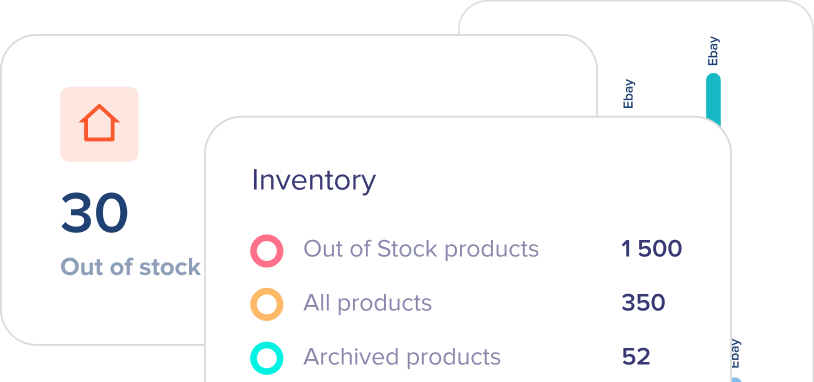
Centralized warehouse management connects inventory, orders, shipping, purchasing, and catalog information in one operational workflow. When an order is placed, stock can be allocated based on the latest available quantity. When goods are received, available inventory can update across connected channels. When an order ships, tracking and order status can be shared without repeated manual entry.
This does not mean every process should be automated without oversight. Automation works best when the underlying rules are clear. For example, routing orders to a warehouse based on stock availability can reduce split shipments. But the rules must account for product restrictions, carrier service levels, wholesale allocations, and safety stock. Automation amplifies good controls and exposes weak ones.
A platform such as eSwap helps merchants centralize those connected workflows, giving warehouse teams and commerce operators a common view of inventory, orders, shipping activity, and purchasing requirements. The practical benefit is less time reconciling systems and more time managing exceptions that actually need human judgment.
Metrics that expose warehouse problems early
Warehouse performance should be measured with operational metrics, not just the number of orders shipped. Volume can rise while accuracy, margin, and customer satisfaction decline. The right metrics show whether the process is holding up as the business scales.
Track inventory accuracy by comparing system quantities with cycle-count results. Monitor order accuracy through mis-picks, returns caused by fulfillment errors, and shipment corrections. Measure fulfillment time from order release to carrier handoff, especially against stated handling promises. Review pick productivity, but balance it against error rates so speed is not rewarded at the expense of quality.
It is also useful to watch the age of unfulfilled orders, stockout frequency for high-demand items, and the percentage of orders requiring manual intervention. These indicators reveal whether the issue is labor capacity, poor inventory data, unclear routing rules, or a catalog problem such as missing dimensions or incorrect product mappings.
Cycle counting is particularly valuable because it identifies errors before they affect customers. Rather than shutting down the warehouse for a full physical count, teams can count selected locations or high-risk SKUs on a schedule. Fast-moving, high-value, and frequently adjusted items should be counted more often than stable, low-volume stock.
Build a warehouse process that can scale
Scaling does not always mean adding more space or headcount. Often, the first constraint is process visibility. If supervisors cannot see where inventory is, why an order is held, or what the team is working on, adding people can multiply confusion.
Start by documenting the physical flow from receiving through shipping. Identify where staff re-enter information, where stock changes status without a system update, and where orders wait for approval. Then standardize the highest-volume paths first. Clear exception handling matters as much as the normal path, because damaged stock, partial receipts, address issues, and split orders are where manual work expands.
Give every inventory adjustment a reason code and approval path. Train staff to scan or confirm movements at the time they happen, not at the end of a shift. Keep product, bin, and order data clean enough that a new team member can follow the process without relying on tribal knowledge.
The warehouse becomes a growth engine when each order can move with accurate data, clear accountability, and minimal manual coordination. That is the control that lets a seller add channels, products, and volume without turning fulfillment into a daily recovery operation.