
A listing goes live with the wrong title on Amazon, the wrong quantity on Walmart, and an outdated image on eBay, and the damage spreads fast. Sales slow down, returns increase, support tickets pile up, and your team starts fixing channel errors one by one. That is exactly where marketplace listing management software earns its place. It gives growing sellers a controlled way to manage product data across channels without relying on spreadsheets, copy-paste work, or disconnected marketplace dashboards.

For multichannel businesses, listing management is not just a catalog task. It affects inventory accuracy, search visibility, fulfillment speed, and customer trust. When listings are inconsistent, every downstream workflow gets harder. When they are centralized and structured, operations become faster and far more predictable.
What marketplace listing management software actually does
At a basic level, marketplace listing management software centralizes product information and pushes it to multiple sales channels. That includes titles, descriptions, images, pricing, item specifics, SKUs, categories, and other attributes required by each marketplace. Instead of updating listings separately inside Amazon, eBay, Walmart, Shopify, and other systems, teams work from one source of truth.
The real value shows up when the software does more than publish product content. Strong platforms also connect listing management to live inventory, order activity, warehouse workflows, purchasing, and shipping rules. That matters because listings do not operate in isolation. If your catalog says one thing but your stock levels say another, you get oversells. If your listing data is clean but your warehouse cannot locate the item quickly, fulfillment still suffers.
This is why serious sellers tend to outgrow tools that only edit titles and descriptions. They need software that treats listings as part of the broader commerce operation.
Why marketplace listing management software matters more as you scale
A small catalog with one or two channels can often be managed manually for a while. The math changes when you add marketplaces, variants, warehouses, bundles, or wholesale accounts. Each new channel introduces different listing rules, category structures, image requirements, and sync risks.
At that point, manual listing management becomes expensive in ways that are easy to underestimate. Your team spends hours correcting data mismatches. Inventory planners lose confidence in available stock. Fulfillment teams work around SKU confusion. Marketing promotions go live with pricing inconsistencies. None of those issues look dramatic in isolation, but together they create operational drag that slows growth.
Marketplace listing management software reduces that drag by standardizing how product data is created, approved, updated, and distributed. It also shortens the time between a catalog change and that change appearing everywhere it needs to appear.
The operational problems it should solve
The first problem is duplicate work. If your staff has to log into multiple marketplaces to update the same item, you are paying repeatedly for the same task. Centralized listing control removes that repetition and reduces the chance of conflicting edits.
The second problem is inconsistency. Different teams often touch product data for different reasons. Merchandising updates descriptions, warehouse staff creates internal SKUs, and marketplace specialists adjust category attributes. Without system control, listings drift. A good platform keeps those updates organized so every channel reflects the right version of the product.
The third problem is poor visibility. Sellers need to know which listings are active, suppressed, incomplete, out of sync, or failing channel requirements. If your software cannot surface those issues clearly, your team ends up reacting after sales have already been lost.
The fourth problem is inventory disconnect. Listing software should not sit apart from stock control. If it does, you still face the same core risk: selling products that are unavailable, delayed, or allocated elsewhere.
What to look for in marketplace listing management software
Catalog centralization should be non-negotiable. You need one place to maintain product records, variants, images, identifiers, and marketplace-specific attributes. That central catalog should support clean SKU structure and make it easy to update products in bulk when needed.
Channel synchronization matters just as much. Software should push listing updates reliably across marketplaces and reflect status changes quickly. Slow sync creates overselling risk and leaves room for conflicting product data.
Inventory integration is where many tools separate into basic and operationally useful. If listing management is not tied to available stock, reserved quantities, inbound purchasing, and warehouse locations, your team will still be making decisions with partial information.
Workflow control is another major factor. As your business grows, product changes should not depend on tribal knowledge. Look for approval flows, user permissions, edit history, and clear exception handling. These controls help prevent small catalog errors from becoming channel-wide problems.
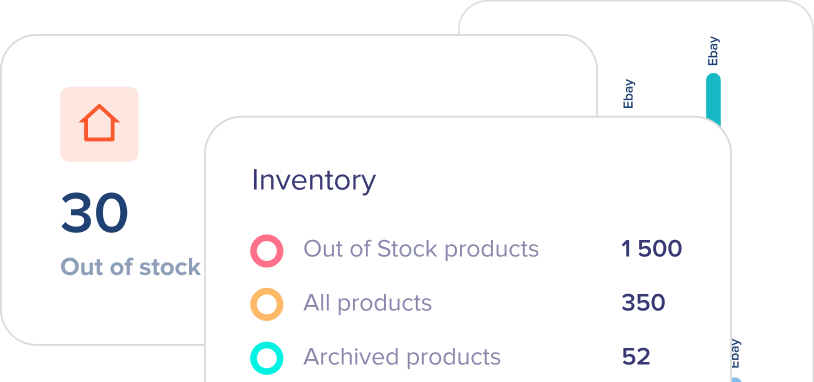
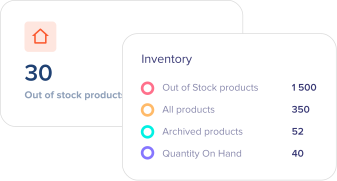
Reporting also matters, but it should be practical. You need visibility into listing health, sales channel performance, stock availability, and product-level exceptions. A polished dashboard is not enough if it cannot help your team act faster.
Marketplace listing management software and inventory control belong together
For many sellers, the biggest misconception is treating listings as a front-end marketing job rather than an operations function. Listings absolutely affect conversion, but they also define how products move through inventory, fulfillment, returns, and replenishment.
A centralized system brings those pieces together. When a product is updated, stock changes can flow across channels. When a new SKU is created, it can be tied to warehouse handling logic. When a bundle is listed, component inventory can be tracked correctly. This is where software starts delivering real control instead of just convenience.
That control becomes even more valuable for businesses managing multiple warehouses, FBA and merchant-fulfilled inventory, or both direct-to-consumer and wholesale channels. In those environments, listing accuracy depends on operational accuracy. One cannot stay healthy for long without the other.
Where lighter tools fall short
Some listing tools work well for early-stage sellers with a narrow product range and limited channel complexity. They can help publish listings faster or simplify basic edits. The trade-off is that many of them stop at the catalog layer.
If your business is growing, that limitation shows up quickly. You still need separate systems for orders, shipping, warehouse activity, and purchasing. Staff ends up reconciling data between tools, and the same item may exist in multiple formats across the stack. The result is more maintenance, not less.
This does not mean every seller needs a large operational platform on day one. It does mean the right software depends on where complexity is coming from. If your pain point is occasional listing edits, a basic tool may be enough. If your pain point is channel sprawl, overselling, warehouse pressure, and disconnected workflows, you need software built for operational coordination.
Choosing software based on your business model
A reseller with fast-changing inventory needs speed and bulk editing. A branded merchant with variants and rich product content needs attribute control and channel consistency. A warehouse-heavy seller needs listing management tied closely to inventory availability and fulfillment logic. A wholesale business may need the same product data to support both marketplace listings and B2B ordering workflows.
That is why feature comparisons alone do not tell the full story. The better question is whether the software fits the way your business actually runs. Can it support your SKU count, order volume, warehouse model, and channel mix without adding new manual work? Can it give operations, inventory, and fulfillment teams the same live view of the catalog? Can it scale as more channels, products, and users are added?
For businesses dealing with those demands, a platform approach often makes more sense than a point solution. Systems like eSwap are built around that operational reality, connecting listings with inventory, orders, warehouses, shipping, and purchasing so teams can run multichannel commerce from one environment instead of patching together separate tools.
The business outcome is control
The best marketplace listing management software does more than clean up product pages. It gives sellers tighter control over how products are represented, sold, stocked, and fulfilled across every channel. That control leads to fewer listing errors, better stock accuracy, faster execution, and less time spent fixing preventable issues.
For growing merchants, that is the real decision. Not whether software can help publish listings, but whether it can reduce operational friction across the business. When your catalog, inventory, and fulfillment processes work from the same system, scaling gets a lot less chaotic.
If your team is spending more time correcting marketplace data than moving the business forward, it is probably time to treat listing management like the operational priority it already is.