
A shipping tool that prints labels faster will not fix inventory that is wrong, orders that arrive late from marketplaces, or warehouse teams working from disconnected screens. A useful multichannel shipping software review must look beyond carrier rates and label generation to determine whether the system gives your operation control as order volume, channels, and fulfillment complexity increase.

For sellers managing Shopify, Amazon, eBay, Walmart, wholesale orders, and multiple warehouses, shipping is the final operational handoff. It is also where upstream problems become expensive. The right platform should connect order routing, inventory availability, warehouse execution, carrier selection, and customer delivery expectations in one workflow.
What a multichannel shipping software review should test
The first question is not whether the software supports your preferred carrier. Most platforms can connect to major carriers. The more valuable question is whether shipping data moves reliably between every part of the operation.
When an order is received, the system should confirm stock availability, apply the correct fulfillment rules, select the appropriate warehouse or shipping method, create the shipment, update the sales channel, and preserve a clear record of what happened. If staff must export orders, check inventory in another system, and manually upload tracking details, the operation still depends on workarounds.
A serious review should assess the platform across four connected areas: channel connectivity, shipping execution, warehouse control, and data accuracy. These functions determine whether the software reduces operational effort or simply adds another dashboard.
| Review area | What to look for | Why it matters | |—|—|—| | Channel integrations | Two-way order, inventory, listing, and tracking updates | Prevents delayed updates and overselling across channels | | Carrier management | Rate shopping, service rules, label creation, and tracking | Controls shipping cost without slowing fulfillment | | Warehouse workflows | Pick, pack, scan, routing, and multi-location support | Makes daily fulfillment repeatable as volume rises | | Inventory synchronization | Real-time stock adjustments and reserved inventory logic | Protects available stock data from order to shipment | | Automation | Rules based on channel, order value, destination, SKU, or service level | Reduces repetitive decisions and manual errors |
Start with the orders you actually fulfill
Software demos can make shipping look simple because they often show one order, one warehouse, and one carrier. Your review should use real operating scenarios instead. Consider what happens when the same SKU sells on two marketplaces, a customer selects expedited delivery, one warehouse is short on stock, and a partial shipment is required.
A platform should handle these exceptions without forcing the team to create manual fixes. Review how it imports orders from each channel, how quickly it updates statuses, and whether it supports channel-specific shipping requirements. Marketplace orders may have different handling times, label formats, service restrictions, and tracking expectations than orders from a direct-to-consumer store.
Also check the quality of the integration, not just the presence of an integration badge. A connection that imports orders but does not push shipment confirmations back promptly creates support issues and can affect marketplace performance. Two-way synchronization is operationally more valuable than a one-time data import.
Evaluate carrier tools in the context of cost and control
Carrier rate comparison is useful, but lowest cost is not always the right result. A low-cost service may miss a delivery promise, lack appropriate coverage, or create more customer service work for high-value orders. The best shipping software lets operators build rules that balance cost, delivery speed, package characteristics, and destination.
For example, an operator may want to route lightweight domestic parcels through one carrier, use another service for residential zones, and require signature confirmation above a defined order value. These decisions should happen automatically when the order meets clear conditions. Staff should not have to remember a separate shipping policy for every channel or customer type.
Look for control over shipping rules, package presets, service mappings, label formats, return labels, and tracking notifications. If the business ships internationally, assess customs documentation, duties-related data, harmonized codes, and address validation as well. International support that works only for a basic parcel does not necessarily support a growing global operation.
There is a trade-off here. Highly configurable rules require time to set up and test. For a business shipping a few orders per day, a simpler tool may be enough. For a team processing hundreds or thousands of orders across channels, rules reduce dependence on individual employee knowledge and create more consistent outcomes.
Do not separate shipping from inventory accuracy
Shipping performance depends on accurate inventory. A label can be generated in seconds, but that speed has little value if the item was already allocated to another order or stored in a different location than the system indicates.
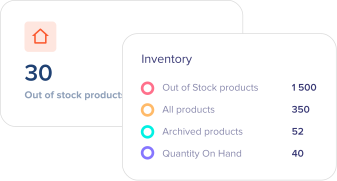
Review how the software treats available, allocated, incoming, damaged, and warehouse-specific stock. It should make it clear when inventory is reserved for an order and when that reservation changes. This becomes especially important when the same catalog is sold through marketplaces, online stores, B2B channels, and manual sales orders.
Multi-warehouse operations need another level of control. The platform should help determine where an order is fulfilled based on stock availability, proximity, shipping service, warehouse capacity, or channel rules. Without routing logic, teams may ship from the wrong location, split orders unnecessarily, or transfer inventory too late.
This is where a broader commerce operations system can provide more value than a label-only application. eSwap centralizes inventory, orders, shipping, warehouse workflows, purchasing, catalog management, and B2B operations so shipping decisions are based on current operational data rather than disconnected records.
Test warehouse usability under pressure
Warehouse teams need fast, clear instructions. A shipping platform should make it easy to move from released order to picked item, packed parcel, printed label, and shipment confirmation without losing traceability.
Ask how the system supports batch picking, barcode scanning, packing verification, exception handling, and partial fulfillment. If workers scan the wrong SKU, the workflow should flag the issue before a label is printed. If an item is unavailable, the team should be able to escalate or reroute the order without corrupting inventory records.
Usability matters as much as features. A system with extensive configuration may be powerful, but it can fail if warehouse users need several screens and manual notes to process a standard order. Run a live test with the people who pick and pack orders. Their feedback will reveal friction that is not visible in an administrative demo.
Look for reporting that improves decisions
Shipping data should support more than tracking lookups. Operators need visibility into shipping spend by carrier, service, channel, warehouse, destination, and order type. They also need to see fulfillment turnaround time, exception rates, split-shipment frequency, and orders awaiting action.
The goal is not to collect every possible metric. It is to identify where cost, delays, and errors originate. If one marketplace consistently creates address issues, or a specific warehouse has a higher mis-pick rate, reporting should make the pattern visible early enough to act on it.
Review whether reports can be filtered by date range, channel, warehouse, carrier, and fulfillment status. Check whether the data reflects real-time operations or requires delayed exports. Reliable reporting depends on the same connected data model that supports accurate order and inventory management.
Questions to ask before you commit
Before selecting a platform, ask the vendor to demonstrate your most common and most difficult workflows. Include a multi-item order, an out-of-stock scenario, a split shipment, a marketplace order with strict handling requirements, and a return. Confirm what is automated, what requires a user decision, and what happens when an integration fails.
You should also understand implementation requirements. Migrating shipping operations may involve carrier accounts, SKU data cleanup, warehouse location mapping, shipping rule design, staff training, and testing. A platform can save substantial time after launch, but only if the setup reflects the way your business actually operates.
The best choice is the one that gives your team more control without creating more screens, duplicate data, or manual exceptions. When shipping, inventory, orders, and warehouse work operate from the same source of truth, growth becomes a capacity decision rather than a daily operational gamble.