A bestselling SKU can become a liability the moment inventory reaches zero while a purchase order is still days away. Orders keep arriving from Shopify, Amazon, wholesale accounts, and other channels, but the product is unavailable. The result is canceled orders, damaged marketplace performance, rushed replenishment, and customers who may not return. So, what is safety stock? It is the extra inventory a business keeps on hand to absorb uncertainty in demand, supplier lead times, and fulfillment operations.
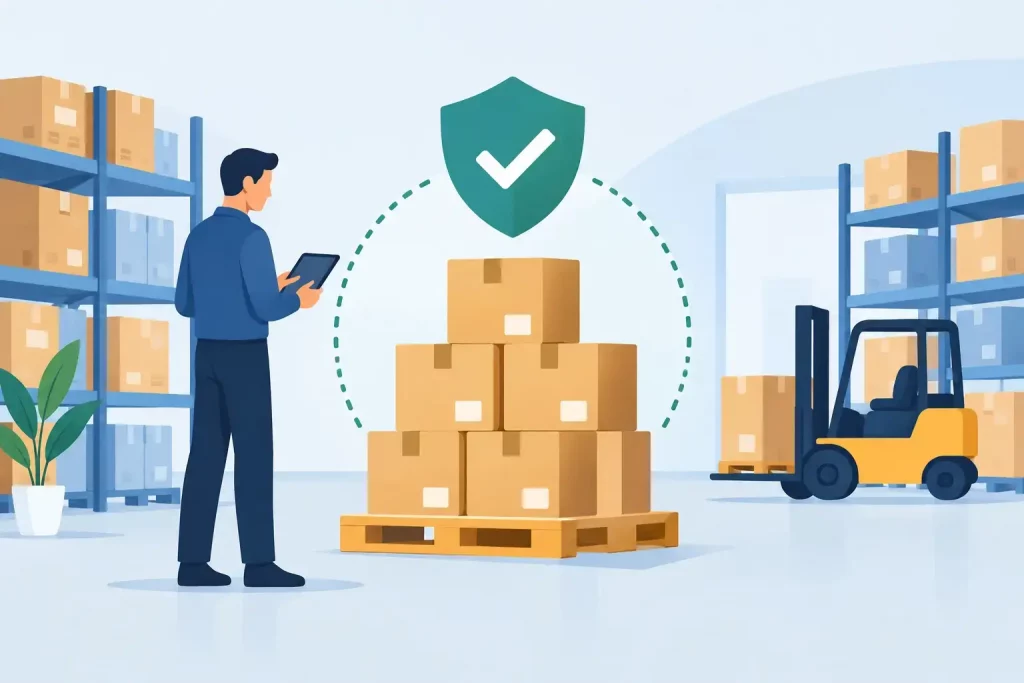
Safety stock is not inventory for its own sake. It is a planned buffer that protects service levels when actual conditions differ from the forecast. For multichannel merchants, that buffer can be the difference between shipping on time and overselling across several sales channels.
What Is Safety Stock in Inventory Management?
Safety stock is inventory held above expected demand during a replenishment period. If you expect to sell 100 units before your next delivery arrives, and you keep another 25 units in reserve, those 25 units are your safety stock.
The key word is uncertainty. Forecasts are based on averages, but operations rarely run on average. A social post may lift sales overnight. A supplier may ship late. A carrier delay may hold up inbound inventory. A wholesale customer may place an order that was not included in the forecast. Safety stock provides room to respond without interrupting fulfillment.
It is different from cycle stock, which is the inventory you expect to sell during normal demand between replenishment orders. It is also different from excess inventory. Excess stock has no clear operational purpose and can tie up cash, warehouse space, and attention. Safety stock has a defined job: reducing the risk of a stockout at an acceptable cost.
Why Safety Stock Matters for Multichannel Sellers
A stockout is rarely limited to one missed sale. On marketplaces, unavailable products can affect listing momentum, seller metrics, and customer trust. On direct-to-consumer stores, shoppers may leave for a competitor rather than wait for a restock. In wholesale, failing to fill an order can strain a relationship that took time to build.
Multichannel operations create another layer of risk. A product may appear available in several storefronts, marketplaces, and B2B catalogs at once. If inventory updates are delayed or disconnected, the same units can be sold twice. Safety stock helps, but it cannot compensate for inaccurate inventory data. Businesses need one reliable view of on-hand, allocated, inbound, and available inventory across every channel.
A well-managed buffer supports more consistent fulfillment without forcing a business to overbuy every SKU. That distinction matters. Carrying too little inventory risks lost revenue. Carrying too much consumes working capital and warehouse capacity. The goal is not maximum stock. It is the right level of protection for each product.
How to Calculate Safety Stock
There is no single safety stock formula that fits every catalog. The right method depends on sales volatility, lead-time reliability, product value, supplier performance, and the cost of being out of stock. A stable, low-volume item can use a simple calculation. Fast-moving products with unpredictable demand need a more detailed approach.
A simple safety stock formula
A common starting point is:
Safety stock = (Maximum daily sales × Maximum lead time) – (Average daily sales × Average lead time)
Assume a product usually sells 10 units per day and your supplier typically delivers in 14 days. Under normal conditions, you need 140 units to cover expected demand during that lead time. But if demand can reach 15 units per day and the supplier can take up to 18 days, your maximum exposure is 270 units.
Your safety stock would be 130 units: 270 minus 140.
This approach is easy to understand and useful when historical data is limited. Its weakness is that a single unusual sales spike or one supplier delay can distort the result. Review the inputs regularly instead of treating them as permanent assumptions.
A service-level approach for higher-volume operations
Businesses with stronger demand history often calculate safety stock using demand variability and lead-time variability. This method starts with a target service level, such as 95% or 98%, then estimates the inventory needed to achieve it.
A higher service level means fewer stockouts, but it also means more inventory and higher carrying costs. A 99% target may make sense for a high-margin product that drives repeat purchases or supports critical wholesale accounts. It may not make sense for slow-moving, seasonal, or perishable inventory.
The quality of the calculation depends on the quality of the data. If orders, returns, purchase orders, warehouse movements, and channel inventory are maintained in separate spreadsheets or systems, planners may be working from incomplete numbers. Centralized inventory operations make it easier to identify real sales patterns and supplier performance before setting reorder rules.

Set Reorder Points Alongside Safety Stock
Safety stock works with a reorder point. The reorder point tells your team or system when it is time to buy more inventory. It should account for expected sales during lead time plus the safety stock buffer.
Reorder point = Average daily sales × Average lead time + Safety stock
Using the earlier example, expected demand during a 14-day lead time is 140 units. With 130 units of safety stock, the reorder point is 270 units. When available inventory falls to 270 units, it is time to replenish.
Available inventory should be the number used for this decision, not simply on-hand inventory. On-hand units may already be allocated to open orders, reserved for wholesale customers, damaged, in transfer between warehouses, or committed to another channel. Accurate availability prevents a reorder point from creating false confidence.
Which Products Need More Safety Stock?
Safety stock should not be applied as one blanket rule across the catalog. Product-level planning is more accurate and protects capital. High-demand products with volatile sales usually need more protection than predictable, low-volume items.
Give closer attention to products with inconsistent supplier lead times, long replenishment cycles, high sales velocity, seasonal demand swings, or strong marketplace dependency. A product that sells steadily but takes 60 days to replenish may need a larger buffer than a product with more variable demand that can be reordered and received within a week.
Margin also matters. It can be reasonable to hold extra units of a profitable item when a stockout would cost far more than the carrying expense. For low-margin products that occupy substantial warehouse space, a leaner buffer may be the smarter choice. There is no universal right answer because the economics of each SKU are different.
Common Safety Stock Mistakes
The most common mistake is setting a buffer once and never revisiting it. Sales patterns change, suppliers improve or decline, and new channels alter demand. A safety stock level that was correct six months ago can be too low or too high today.
Another mistake is using sales history without separating unusual events. A one-time promotion, marketplace outage, bulk wholesale order, or stockout period can skew average demand. Inventory planners should review the context behind the data, especially for key products.
Many businesses also ignore lead-time variation. A supplier may quote a 30-day lead time, but actual deliveries may range from 25 to 45 days. Planning only around the quoted number leaves the business exposed. Measure the time from purchase order placement to inventory available for sale, including receiving and putaway delays.
Finally, do not treat safety stock as a substitute for operational control. If channel listings do not update quickly, purchase orders are not tracked, or warehouse counts are unreliable, extra inventory may only hide a process problem for a while.
Use Automation to Keep Safety Stock Accurate
Safety stock is most useful when it is connected to live inventory activity. As orders flow in from multiple channels, inventory should update centrally. As purchase orders are received, available stock and reorder status should change without manual reconciliation. As demand trends shift, teams should be able to see which SKUs need attention before they create fulfillment problems.
For growing merchants, this is where an operations platform such as eSwap can reduce the spreadsheet work behind inventory planning. Centralizing orders, warehouses, purchasing, and multichannel inventory gives teams a clearer basis for setting reorder points and protecting stock availability.
Review your safety stock at a regular cadence, with more frequent checks for fast-moving or seasonal SKUs. The best buffer is not the largest one. It is the one that gives customers reliable availability while keeping your cash, warehouse space, and purchasing decisions under control.